

1966 OCEAN BEACH
The Contest That Changed Everything
How six days at Ocean Beach in 1966 turned surfing from beach culture into world culture
There are surf contests, and then there are hinge points in history.
The 1966 World Surfing Championships at Ocean Beach, San Diego, was the latter.
You can draw a clean line through modern surfing and stop it right there—beneath the new concrete span of the Ocean Beach Pier, in a beach town still rough around the edges, where the old style met the new one in public, under television cameras, in front of a crowd big enough to suggest surfing was about to become something larger than itself.
Before Ocean Beach, surfing still belonged mostly to the tribe. After Ocean Beach, it belonged—at least potentially—to the world.
That’s not romantic inflation. That’s what happened.
Held from late September into early October of 1966, the event brought together the finest surfers on the planet, from California, Hawaii, Australia, Peru and beyond, and staged their collision at a break as democratic and visible as any in the country. More than 10,000 spectators turned up, with the new Ocean Beach Pier serving as both grandstand and monument, and ABC cameras turning what had once been a local obsession into a broadcast-ready spectacle. It was the first World Championships held in the United States, and it delivered something no one in surfing had ever seen before: proof that this strange, beautiful pastime could support a legitimate audience, a modern mythology, and eventually, a professional future.
But like all truly great surf stories, the official version only tells part of it.
The rest lives in the margins—in motel parking lots, on pier pylons, in local club pride, in handmade boards, in improvised pageantry, and in the people who understood, before most of the world did, that surfing needed ambassadors as much as it needed athletes.
And few understood that better than Miss Billy Riley.
There are surf contests, and then there are hinge points in history.
You can draw a clean line through modern surfing and stop it right there. Beneath the new concrete span of the Ocean Beach Pier, in a beach town still rough around the edges, where the old classic style of surfing met the new aggressive style in public, under television cameras, in front of a crowd big enough to suggest surfing was about to become something larger than itself.
There are surf contests, and then there are hinge points in history.
The 1966 World Surfing Championships at Ocean Beach, San Diego, was the latter.
You can draw a clean line through modern surfing and stop it right there—beneath the new concrete span of the Ocean Beach Pier, in a beach town still rough around the edges, where the old style met the new one in public, under television cameras, in front of a crowd big enough to suggest surfing was about to become something larger than itself.
Before Ocean Beach, surfing still belonged mostly to the tribe. After Ocean Beach, it belonged—at least potentially—to the world.
That’s not romantic inflation. That’s what happened.
Held from late September into early October of 1966, the event brought together the finest surfers on the planet, from California, Hawaii, Australia, Peru and beyond, and staged their collision at a break as democratic and visible as any in the country. More than 10,000 spectators turned up, with the new Ocean Beach Pier serving as both grandstand and monument, and ABC cameras turning what had once been a local obsession into a broadcast-ready spectacle. It was the first World Championships held in the United States, and it delivered something no one in surfing had ever seen before: proof that this strange, beautiful pastime could support a legitimate audience, a modern mythology, and eventually, a professional future.
But like all truly great surf stories, the official version only tells part of it.
The rest lives in the margins—in motel parking lots, on pier pylons, in local club pride, in handmade boards, in improvised pageantry, and in the people who understood, before most of the world did, that surfing needed ambassadors as much as it needed athletes.
And few understood that better than Miss Billy Riley.
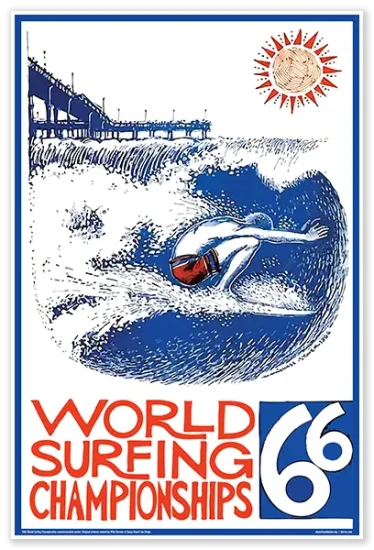
Own a piece of history.
Every poster purchased helps support the San Diego Ocean Beach Pier Renewal Project, making this more than a work of art—it’s a meaningful contribution to the community that inspired it. Get yours today and be part of renewing an icon of San Diego surf history.